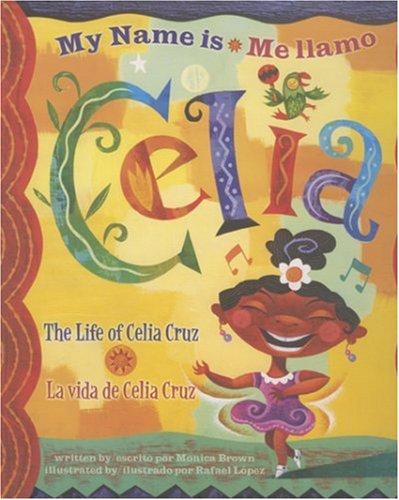
 This bilingual book allows young readers to enter Celia Cruz's life as she becomes a well-known singer in her homeland of Cuba, then moves to New York City and Miami where she and others create a new type of music called salsa.
Customer Review: Queen of Salsa
Celia Cruz is brought to life for young children in this colorful book. Like the tropics from which she came, the book is full of vibrant illustrations. The story is put into simple terms for young readers or a teacher or parent to read. Since the illustrations are so vibrant and bold children will be enthralled by the unique features of the art work. Each biographical page is bilingual for reading in Spanish or English or both. The book describes her early family life in Cuba, her departure after the revolution, her musical group Sonora Mantacera, meeting her musician husband,her associations with other salsa greats like Tito Puente and Willie Colon, her relocation to Miami and the various honors and recognitions she achieved. This is a great little book for primary and middle school libraries as well as community libraries. Students whoose first language is Spanish can benefit from the bilingual book through middle school years. This is a fun book.
Customer Review: Wonderful!
My Name is Celia: The Life of Celia Cruz is written by Monica Brown and illustrated by Rafael Lopez. The book is the recipient of a Pura Belpre' Illustrator Honor Award for outstanding work that portrays, affirms and celebrates the Latino cultural experience in an outstanding work of literature for children and youth. The exciting and inspirational life of beloved Cuban-born salsa queen, Celia Cruz, is celebrated in the bilingual book My Name is Celia Me Llamo Celia: The Life of Celia Cruz. Celia was born in Havana to a large family where their lives were intertwined and music was an important part of everyday life. Celia's papa wanted her to become a teacher but music filled her soul with happiness. She was encouraged by a teacher to "go out into the world and sing...." Celia experienced prejudice and fled her beloved country Cuba when the revolution began. From Cuba, Celia traveled the world sharing her love of music with the world. Rafael Lopez' illustrations are vibrant, fluid combinations of color that beg to be studied. The scenes fill the page and stir emotions as you read the story and live it through his drawings. Armchair Interviews says: My Name is Celia: The Life of Celia Cruz is a beautiful and educational addition to any child's library. We highly recommend it.
Irish Astrology, also referred to as Celtic Astrology, is the astrological system practised by the ancient Irish or the Druids. Described in old Irish manuscripts it is based on an Irish Celtic Symbol system and not on any of the traditional systems such as Western, Chinese or Vedic astrologies.
The Celtic Zodiac is drawn from the beliefs of the Druids and is based on the cycles of the moon. The year is divided into 13 lunar months, with a tree (sacred to the druids) assigned to each month. Each tree has particular magical qualities whose secret mysteries come from the ancient shamanic alphabet, the Ogram. The origin of this Tree Alphabet is ascribed to the God of Poetry and Eloquence of Celtic Ireland, Ogam. He is also known as the Celtic Herkules.
The Druids were Celtic priests who inhabited much of Western Europe, Britain and Ireland until they were supplanted by the Roman government and, later, by the arrival of Christianity.
Some renowned Celtic scholars noticed, thanks to their vast understanding, that their were parallels between Celtic astrology and Vedic astrology. They discovered that the ancient Celtic astrologers used similar systems as those of the Vedic astrologers. Or perhaps vice versa.
Greek and Latin writers spoke of how the Celts were not only advanced in astronomy but that they were respected, especially by the Greeks, for their 'speculations from the stars'. Even the Romans paid tribute to their astronomy with some classical writers going as far as to say that the Celts were "masters of astronomy". One of the first to note that the ancient Celts believed the world to be round (not flat) was Martial (c. AD 40-103) who himself claimed Celtic ancestry.
The Irish (and the Celts generally) have a long tradition of astrological learning stretching back to a time before Christianity and the incoming of Greek and Latin learning. For too long now this rich tradition of Celtic Astrology has been sadly neglected.
Irish Astrology is about bringing awareness of the Celtic Symbolism that was used by the Druids in creating an astrological system that was used as early as the Vedic, Greek, or Roman systems. Click here for more info on Celtic Tree Astrology and Celtic Symbols
90s dance music