Originally released in March 1964, this collaboration between saxophonist Stan Getz and guitarist João Gilberto came at seemingly the end of the bossa nova craze Getz himself had sparked in 1962 with
Jazz Samba, his release with American guitarist Charlie Byrd.
Jazz Samba remains the only jazz album to reach number one in the pop charts. In fact, the story goes that Getz had to push for the release of
Getz/Gilberto since the company did not want to compete with its own hit; it was a good thing he did.
Getz/Gilberto, which featured composer Antonio Carlos Jobim on piano, not only yielded the hit "Girl from Ipanema" (sung by Astrud Gilberto, the guitarist's wife, who had no professional experience) but also "Corcovado" ("Quiet Night")--an instant standard, and the definitive version of "Desafinado."
Getz/Gilberto spent 96 weeks in the charts and won four Grammys. It remains one of those rare cases in popular music where commercial success matches artistic merit. Bossa nova's "cool" aesthetic--with its understated rhythms, rich harmonies, and slightly detached delivery--had been influenced, in part, by cool jazz. Gilberto in particular was a Stan Getz fan. Getz, with his lyricism, the bittersweet longing in his sound, and his restrained but strong swing, was the perfect fit. His lines, at once decisive and evanescent, focus the rest of the group's performance without overpowering. A classic.
--Fernando GonzalezCustomer Review: Wonderful Music!
Wonderful and relaxing music. Very soft, wonderful sound tracks. There are two soundtracks of "The Girl From Ipanema," with the first being the ultimate recording. I would highly recommend this CD for anyone who enjoys cool jazz or any relaxing International-style music.
Customer Review: A Serendipitous Masterpiece
In history, seemingly all great things are happenstance. One could certainly say the same about this serendipitous recording. A quiet, gentle, beautiful record of 8 songs (and 2 reprises) it created a time capsule of that era that surprisingly stands up to todays standards. A great album to relax to, put it on when you need to seriously unwind without drugs or alcohol. It works amazingly well.
Dance has been an important part of rituals, celebrations and entertainment since before the birth of human civilisation. In the beginning, before we had written language to record things, the purpose of dance was often to tell stories and to pass them down to future generations.
The story of dancing in Cuba
In Cuba, as in ancient times, dance tells its own story. The passion and energy of Cuban dance reveals the strength and conviction of the Cuban people, determined to enjoy life despite 'la lucha' (the struggle) of living in a strictly regulated country where the average monthly wage comes in at around 400 pesos - less than 10.
The richness of Cuban music and dancing also tells the story of Cuba's melting pot of cultures. From the high-stepping flamenco brought by the Spanish settlers in the 15th century to the frenzied tribal dances of the West African slaves, dancing is in the blood of the Cuban people.
From the teenage girl in denim shorts to the cigar-seller on the street corner, Cubans are given to break into spontaneous dance steps. Furthermore, the people dancing on the streets of Havana are likely to be just as good as the professionals, because in Cuba dancing is simply a way of life.
The variety of Cuban dances
Cuba boasts a huge range of dances including classical ballet, contemporary, flamenco and folk dancing. But it is the partnered routines that appeared in Havana dancehalls between the 1920s and the 1950s - Salsa, rumba, mambo and cha-cha-cha - that can be seen in every Cuban bar, club and street. Of these, Salsa is the most popular dance internationally.
Since the name 'Salsa' (it's Spanish for 'sauce') was coined, Salsa dancing has exploded in popularity in Latin America and across the world. Salsa dancing classes are now hugely popular but to really get into the swing of it a Salsa holiday in Cuba itself is a must.
Tips for Cuban Salsa dancing
If you do take yourself on a Cuban holiday, you'll have the unique experience of watching Cubans Salsa dancing. It sometimes appears that by some genetic aberration they have been born with super flexible joints, defying physics to carry out all the complex manoeuvres they have integrated into the dancing. Their remarkable twisting body movements and natural sense of rhythm will dazzle you.
If you have the right technique, Cuban Salsa is easier to learn than many other forms of dance. The basic footwork is a fairly simple walking motion, pausing every fourth beat, and there are some six basic steps you can follow to make sure you're on the right tracks.
1 Relax
To dance Cuban Salsa well it is important not to rush, but to relax into the steps. Movements should be precise and deliberate in addition to being flowing and smooth.
2 Walk with purpose
Salsa dancing involves a continual circular motion. Couples walk around each other with an imaginary axis between them. This makes turns look smooth and effortless. Walking gives time to untangle your arms after each turn.
3 Have confidence in your lead
The leader (usually the man) should have constant tension in his arms, while his hands guide his Salsa dancing partner around the floor. There is no need to clamp onto each other's hands, only to use the right amount of tension to provide a leading signal.
4 Be flexible when following
In order to follow well, ladies should try to match the tension of their partner. The exception to this is when arms need to be relaxed and flexible to complete arm-twisting Salsa moves without injury!
5 Keep balanced when you spin
The key to all the spectacular spins in Salsa is not to lose your balance. One way to do it is by spotting while you spin - focussing on one spot at each turn - an age-old dance technique.
6 Use your body
In Salsa dancing, ladies should make use of their body and be sensual, playful and creative. This can involve some creative arm movements, going with what feels right and basically showing off a bit. Enjoy!
Emma Lelliott is the general manager of Captivating Cuba, an independent Cuba holiday specialist. With offices in Havana and the UK, Captivating Cuba can offer Cuban Salsa holidays to Havana as well as expert advice on holidays to Varadero and Cayo Coco and lesser known resorts such as Jibacoa and Trinidad.
latin music downloads
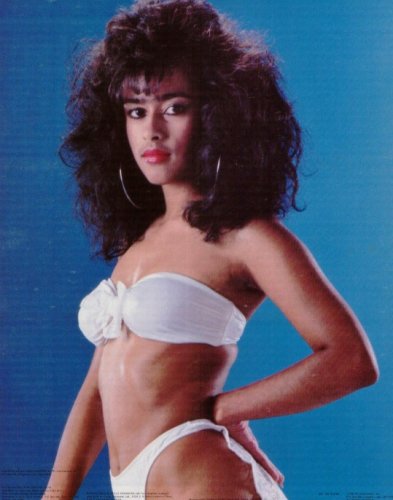 This poster shows a close-up of Rachel Latin Love in a white bikini. This poster measures approx. 16" x 20" A bikini or two-piece is a type of women's swimsuit, characterized by two separate parts, leaving an uncovered area between the two garments. Two-piece garments worn by women for athletic purposes have been observed on Greek urns and paintings, dated as early as 1400 BC. Female athletes who play beach volleyball professionally are required to wear two-pieces.