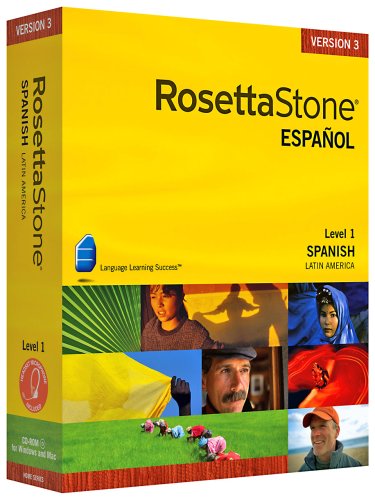
 Why is Rosetta Stone the world's No. 1 language-learning software? Because it works.
 Escape the endless tedium of translation, memorization, and grammar drills. Get the language you want, the skills you need and the success you deserve by learning a new language naturally--the same way you learned your first language.
 |  | |
 The complete immersion environment puts your native language-learning skills to work, eliminating your dependence on tedious translation and rote memorization. | | |
 |  |
| | |||
 Images Images |  |  Intuition Intuition | ||
| ||||
In Rosetta Stone you learn the meaning of new language from clear, real-life images.
In this activity you learn colors. | | You advance using language you've learned and clues from new images. That's your intuition at work.
Now that you know colors, you can easily grasp the meaning of the new words... | ||
| ||||
 Interactivity Interactivity | |  Instruction Instruction | ||
Throughout Rosetta Stone, you constantly interact with the program to confirm your intuition.
...and then check what you've learned. | | From beginning to end you build systematically toward your language-learning goals, for the most effective and enjoyable instruction anywhere.
And finally, you get the fun of trying your new language in a real-life simulation. Speech recognition shows you exactly how you're doing. | ||
| | |||


You learned your first language without translation.
You learned your first language easily and naturally by connecting words to objects and events around you. With Rosetta Stone, learn a new language the same way: using native speakers and thousands of real-life images to help you think in the new language from the very beginning. Studies show that learning exclusively in the new language, without translation as a crutch, is crucial.
The exclusive Dynamic Immersion method reinforces your natural language-learning skills with award-winning instructional technology. Identify your learning goals, then choose customized courses that take you there.
The timeless immersion method, along with research-based techniques and new technologies, make Rosetta Stone the clear solution to your language-learning needs.
What will you be able to do?
Understand everyday language.
Through Rosetta Stone's proficiency-based listening and reading activities, you'll learn quickly.
Pronounce words correctly.
After practicing with Rosetta Stone's speech recognition and analysis tools, pronunciation will come easily.
Speak without a script.
Contextual Formation makes sure you have the confidence and cues you need to get the words out on the spot.
Spell and write accurately.
You'll build gradually from letters to words and sentences.
Engage in real-life conversations.
With Milestone activities, gain confidence using speech alone in simulated situations.
Retain what you learn.
The unique Adaptive Recall reinforces language so it sticks with you in the real world.
Customer Review: Very Simple to Use
Rosetta Stone is very simple to use. However having a Spanish book, or obviously a native speaker to supplement the software would make it much more effective. This is because of being tossed directly into the language without a clear translation leaves the door open for some confusion. Overall a great interactive product that is a strong foundation to start learning a new langauge.
Customer Review: YOU NEED TO KNOW THIS
You cannot legally sell this software when you are done with it. They threatened to sue me when I did - they said I had not bought the software, but a license for the software and it was nontransferrable - that I did not have the right to even GIVE it away.
If you're browsing the internet in search of a satellite radio service for the US and Canada, then you need only check two websites: Sirius and XMRadio. These two giants are your only options and yet you'll notice striking similarities between the two websites' design, the product pricing and the programmer's stations.
Rumors have been flying around that Sirius and XM will form a ground-breaking merger this year, uniting all 14+ million customers under one banner. However, as of right now, you'll need to know what makes each slightly unique.
Country Music Fans may favor the XM Radio satellite service, which provides listeners with two extra stations - one focusing on Americana Country like Robert Plant or Blackfoot, and the other focusing on Folk Country like Tim Garrison and The Nitty Gritty Band. Both stations have country music from the 80s and 90s, new country, bluegrass and classic country.
Christian Music Fans may favor XM one. This service includes one more Christian music channel than Sirius - in addition to Christian Pop / Rock and Gospel, XM also hosts a Southern Gospel channel with Gold City, Greater Vision and The McKarneys.
Electronic Music Fans will prefer the Sirius service if they'd like a Breakbeat/Old SKool station, in addition to the usual Trance/Progressive stations that both satellite radio services provide. XM has exclusive rights to acclaimed BPM, but Sirius has a special Dance Hits station.
Rock Music Fans will probably prefer Sirius. While XM provides four different "alternative radio" stations, a punk station, a heavy metal station, a jam bands station, a college indie station and three classic rock stations, Sirius gives subscribers roughly 23 stations with everything that XM's service has -- plus New Wave, Glam Metal, Jimmy Buffet, Grateful Dead, Elvis, Canadian rock, UK rock, Garage, 60s Rock, 70s Rock and an additional punk/ska station.
World Music Fans will find that both service providers offering two French stations, but Spanish-speaking subscribers will find XM the better option, since they offer Rock En Espanol, Regional Mexican, Latin Pop, Latin Jazz, Hispanic Rhythmic and Spanish AC. Sirius, on the other hand, has only one Spanish music station for Latin Pop. Additionally, XM has a station for African and a business station in Italian.
Rap and Hip Hop Fans may prefer XM because their service focuses on more Soul and Funk, along with uncensored Hip Hop and Urban Contemporary -- unless they're big Slim Shady fans, in which case they may need Sirius Radio's Eminem station.
In some ways, XM Radio caters to the aging population with Good Morning America, Casey Casem's Top 40 Countdown, Theme Time with Bob Dylan and Wolfman Jack. On the other hand, Sirius Radio goes after the 20-somethings crowd with Bam Marguera, Howard Stern, Jamie Foxx and Tony Hawk shows. However, both satellite radio service providers are likely to give you something you can enjoy.
Sports Fans will find many similarities in XM and Sirius service options. For instance, both providers have ESPN, Nascar and NHL exclusives, as well as both college and NFL football. XM gives better golf / PGA Tour coverage and Fox Sports, while Sirius gives better NBA coverage. On XM, catch shows with Jimmy Johnson, Dale Jr, Coach K, James Carville, Luke Russert and Cal Ripkin.
With the Delphi SkiFi2 radio, you can get a sports ticker to show game scores on your display screen and the SportsCaster comes with 30 sports presets programmed in. However, Sirius gives you game alerts, 30 presets and lists all your favorite teams in one category with the Sportster and Streamer satellite radios. Additionally, get exclusive programming with Jerry Rice, Daryl Johnston, Randy Cross, Adam Schein, Shannon Sharpe, Ray Evernham, Tony Stewart, Rick Ackerman and Frank Isola.
Whichever satellite radio service you prefer, you'll be surprised to find that both are competitively priced at $13/month and most of the radio components cost from $20 - $200. However, which ever service you choose for now, you will still need to purchase a satellite radio receiver and luckily, most of the satellite radios will work in your home and in your car.
Get all the information you need on the satellite radio service providers from Mike Selvon's portal, and leave a comment at his satellite radio network blog.
90s dance music
No comments:
Post a Comment